| Price tier | $$ mid-range · subscription, quoted per team |
| Deployment | Cloud only |
| Free trial | ✓ Yes |
| Tested | Three-week pilot, 12-user team, June 2026 |
Interface & onboarding — 9.7
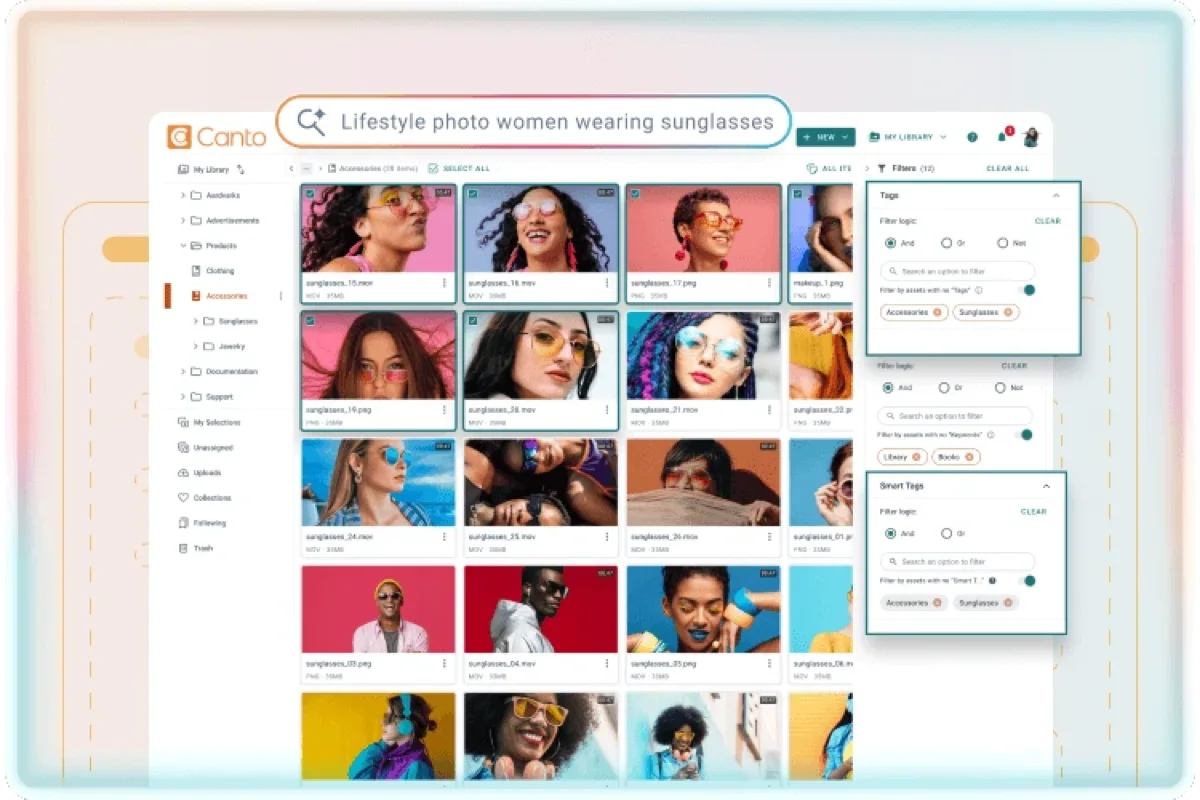
This is the best onboarding story in DAM. Our 12-person pilot team — deliberately non-technical — was uploading, tagging and sharing by the end of day one, self-sufficient by day two, with zero formal training. Albums and visual folders mirror how marketers already think, the filter bar teaches itself, and nothing important hides more than two clicks deep. If adoption anxiety is why you don't have a DAM yet, Canto removes the excuse.
I ran the same 12-person pilot I use for every cloud DAM: give a non-technical marketing team the login on a Monday, no training, and watch what breaks. With Canto, nothing did. By Wednesday two people had built branded share portals I hadn't shown them how to build. That is the number that matters here — not a feature checkbox, but how fast a real team stops asking me questions. Where Canto's shine wears thin is deeper down, in metadata and cost-at-scale, which is what the rest of this review digs into. Full protocol: how we test.
Key features — 9.0
Portals and sharing. Branded portals are Canto's crown jewel: polished, client-ready spaces built in minutes, with expiring links and download presets. Nothing else we tested makes external sharing look this good.
AI tagging. Reliable, with the crucial human review queue — machine keywords wait for approval instead of polluting the taxonomy. Face recognition and text-in-image search both worked as advertised in our runs. We scored the same capability across every tool we tested in our face recognition comparison.

Tester's tip: lean on Canto's natural-language search before you build elaborate folders. Typing "woman in red at trade show" found our planted test shots without a single manual keyword — for marketing libraries that leans the taxonomy work you actually need way down. Pair it with the approval queue so auto-tags stay clean. See our library organization guide.
Search. Fast and forgiving on our 25k test library (0.8s typical). The ceiling shows at scale: on the 100k+ stress set, complex filtered queries stretched past three seconds and pagination grew sluggish — adequate, but a tier below the fastest tools.
Metadata. Custom fields, tag management and decent bulk editing. The round-trip test told the harder story: exports preserved 82% of IPTC fields — captions and rights survived; several structured fields (creator contact, scene codes) didn't. Fine for marketing libraries, disqualifying for archival work against the IPTC standard.
Watch this if you archive: in our export/re-import test Canto preserved 82% of IPTC fields — captions and rights survived, but structured fields like creator contact and scene codes did not. For a marketing library that's fine; for a rights-sensitive photo archive it's a real exit risk. Keep critical rights data in fields that survive, and export full metadata CSVs on a schedule. If lossless round-trip is non-negotiable, see Daminion (100% in the same test).
Pricing — 8.2 on value
Canto quotes per team; as of July 2026 there's no public rate card. Verified G2 and Capterra reports place typical contracts in the mid-range tier — commonly low five figures annually for mid-size teams — with per-user costs that climb noticeably as seats grow, the most repeated complaint in recent reviews.
| Question | Answer |
|---|---|
| Published prices | None. Canto names four packages and prices none of them |
| Packages | DAM · DAM Plus · DAM for Products · DAM Pro |
| What moves the quote | Team size and storage — in Canto’s words, “pricing scales based on your team size and storage needs” |
| Free trial | Yes — 7 days, self-serve sign-up |
| Buyer-reported benchmark | None we can cite: Vendr, which publishes medians for Bynder and Brandfolder, shows no dataset for Canto |
| Checked | September 2026, against Canto’s own pricing and sign-up pages |
What each Canto package adds
Canto’s pricing page lays the packages out as a ladder. The base DAM package is storage, search and security. DAM Plus adds review and approval with proofing, brand templates, AI search and customizable brand portals. DAM for Products layers product data and product catalogs on top, and DAM Pro adds dedicated onboarding, more storage, deeper integrations, multi-language support and extra security and compliance controls. Canto itself calls these packages “illustrative” and says purchases “can be customized” — so treat them as a starting menu, not a rate card.
The practical consequence: the two things most teams come to Canto for — AI search and portals — sit on the second rung of that ladder, not the first. When the quote arrives, ask which package it is built on before comparing it with anyone else’s.
Four questions to put to Canto sales
Because the price moves with seats and storage, pin both down in writing: how many full users versus view-only users the quote covers; how much storage is included and what the next block costs; which package AI search and portals belong to; and what cap applies to the renewal increase. The seven-day trial is long enough to test onboarding — the thing Canto is best at — but too short to judge search on your own library, so load a real sample on day one.
Price tiers: $ budget · $$ mid-range · $$$ premium, quote-based. Most DAM vendors quote final pricing individually, so tiers reflect verified customer reports on G2 and Capterra rather than rate cards. Checked July 2026.
Worked example: a 12-user marketing team with 500 GB should expect a mid-tier annual quote; the same capability profile self-hosted (a budget on-premise tool on existing storage) runs a fraction of that, at the cost of polish and IT ownership. You're paying Canto for adoption speed and client-facing shine — decide whether those drive revenue for you.
Pros & cons
What we liked
- Fastest team onboarding we've tested — productive in a day
- Branded portals that impress clients out of the box
- AI tagging with human approval queue
- Clean admin: roles, usage stats, expiring links
What could be better
- Costs scale steeply with team size (per G2 reports)
- No on-premise or self-hosted option
- Search slows past ~100k assets
- IPTC round-trip lost 18% of fields in our test
Who is Canto for?
✓ Choose Canto if you…
- Run a marketing or brand team that must adopt the tool this quarter
- Share assets with clients and partners constantly
- Keep libraries under ~100k assets
- Have mid-range budget and no server appetite
Final verdict
Excellent — 9.1/10
Canto is the DAM you buy when the biggest risk is that nobody uses the DAM. It trades metadata depth and cost efficiency for adoption and polish — a rational trade for marketing-led teams, a poor one for archives. In our rankings it's the clear #2: the tool we recommend when Daminion's control-first approach isn't what the team needs.
FAQ
Is Canto a good DAM in 2026?
Yes — it scored 9.1/10 in our June 2026 testing, ranking #2 of 23 tools. Its onboarding and branded portals are the best we've seen; its weaknesses are cost growth with team size, cloud-only deployment, and search that slows past roughly 100,000 assets.
How much does Canto cost?
Canto doesn't publish pricing; quotes are per team. Verified G2 and Capterra reviewer reports as of July 2026 place typical contracts in the mid-range DAM tier — commonly low five figures per year for mid-size teams — with per-seat costs rising as teams grow. A free trial is available.
How long does Canto take to roll out?
Fastest in our test: our 12-person pilot was self-sufficient in two days without formal training. Plan extra time only for content migration — roughly a week per 50,000 unorganized files, same as any DAM.
Canto or Daminion — which should I pick?
Canto for marketing teams that prize adoption speed, portals and cloud simplicity; Daminion for teams that need on-premise control, lossless metadata and budget-tier economics on large archives. Our full Daminion vs Canto comparison scores them row by row.
What if we outgrow Canto?
Plan the exit before entry: in our round-trip test Canto exports preserved 82% of IPTC fields, so keep rights and creator data duplicated in fields that survive, and export full metadata CSVs quarterly. Growth pain usually appears as search latency past 100k assets and rising per-seat renewals — the point where teams evaluate self-hosted alternatives.
Sources & references
- Canto Platform — product overview — vendor site, accessed July 2026. Interface screenshots, AI/portal feature set.
- IPTC Photo Metadata Standard — International Press Telecommunications Council. Reference for the metadata round-trip test.
- Canto reviews on G2 — accessed July 2026. Verified-customer reports on pricing growth and support.
- Canto reviews on Capterra — accessed July 2026. Second independent ratings source.
- PhotoLib in-house test — three-week 12-person pilot + 25k/100k library benchmarks, June 2026. Onboarding, search latency and round-trip figures above. See how we test.
- Canto — pricing — vendor site, accessed September 2026. Package names and contents, pricing basis; no prices published.
- Canto — free trial sign-up — vendor site, accessed September 2026. Seven-day free trial.