Our verdict in 30 seconds: Cloudinary is the strongest fit if your product images are generated and served through code — on-the-fly resizing, cropping and background removal via API, with no manual export step per marketplace. Canto (8.9) is the better pick if your team needs an actual browsable library, not just an API, to manage product photography day to day. Pics.io and Bynder cover the budget and large-catalog-governance ends of the spectrum respectively.
What e-commerce actually needs from a DAM: renditions, not just storage
Most DAM buying guides treat "storage and search" as the whole job. E-commerce adds a layer most teams underestimate until it bites them: every product typically needs several renditions — a square marketplace thumbnail, a zoomed detail crop, a background-removed cutout for a different template, a compressed mobile version — and if your master photo changes (new packaging, corrected color), every one of those derived copies needs to update too, across every channel it was pushed to. We tested specifically for that rendition-generation and update behavior, not just basic asset storage.
My test: replace a product master image that already has several renditions in active use (a marketplace thumbnail, a zoom crop), then check whether those derived images update automatically or keep serving the stale version. Cloudinary passed this cleanly because renditions are generated dynamically from the current master by definition — there's no separate stored copy to go stale in the first place. That's a structurally different answer than tools that generate a rendition once and store it as its own file.
The e-commerce job: product images and videos, by SKU and variant
Selling online is where a DAM stops being a tidy archive and turns into plumbing. The job is narrower than “store our media”: organize every product image and video against the SKU and variant it belongs to, then feed the right rendition to wherever the catalog is sold. In practice that means pushing assets into a storefront or PIM — Shopify, Adobe Commerce (Magento), or a product feed — and letting the DAM or its CDN generate sizes on the fly instead of exporting a folder of JPEGs per channel. Video raises the stakes: a 360-degree spin or a demo clip needs the same SKU tagging and transcoded renditions as a still, and most photo-first tools treat it as an afterthought — a gap our media asset management ranking digs into. The payoff is one source of truth: when a product’s packaging changes or a variant is discontinued, you update the master once and every connected channel reflects it, instead of hunting stale images across a dozen listings. Where an image CDN fits into that chain, and where it stops, is covered in DAM vs CDN.
Quick comparison
| Tool | E-commerce strength | Best for | Tier | Score |
|---|---|---|---|---|
| 1. Cloudinary | On-the-fly renditions via API, always current with master | Teams with developers who can build the pipeline | $–$$ | 8.9 |
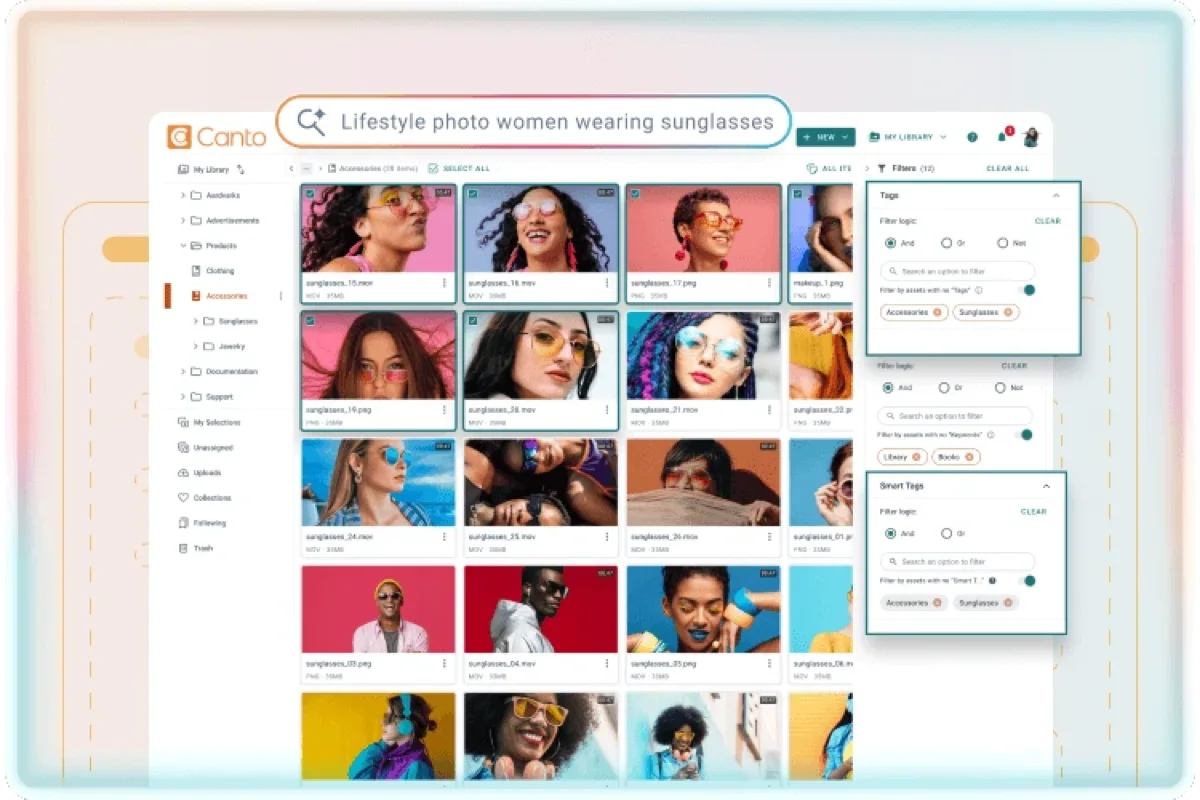
| 2. Canto | Browsable catalog + natural-language search for non-developers | Merchandising/marketing teams managing product photos directly | $$ | 8.9 |
| 3. Bynder | Governance at large catalog scale, multi-brand/region | Large retailers with many product lines or regions | $$$ | 8.5 |
| 4. Pics.io | Budget option built on Google Drive | Smaller online stores already in Google Workspace | $$ | 8.0 |
Price tiers: $ budget · $$ mid-range · $$$ enterprise, quote-based. Scores reflect fit for e-commerce product-image workflows specifically, not each tool's overall PhotoLib score. Checked July 2026.
1. Cloudinary — renditions generated on the fly, always current
Cloudinary
★★★★★ 4.5Best for: teams with developer resources who want product-image transformations handled entirely by API, not manual export.
No figure here: Cloudinary's interface is developer/API-facing rather than a browsable library UI, and we didn't have a real, current interface screenshot on file for this page. Per our house policy we don't substitute a stock mockup for one.
Pros
- Renditions generated dynamically from the current master — nothing to go stale when the master changes
- Automated background removal and marketplace-specific sizing via API, no manual export per channel
- Credit-based pricing scales with usage, not seats — can work well for high-volume automated pipelines
Cons
- Not a browsable library UI — a non-technical merchandising team can't just log in and organize photos without developer-built tooling on top
- Requires engineering time to integrate; not a same-day setup for a small store
Our verdict: If your product images are already handled through code — a PIM, a custom storefront, an automated ingestion pipeline — Cloudinary's on-the-fly rendition model is structurally the right fit, because there's no stale derived copy to manage in the first place.
2. Canto — best for a team that needs to browse the library directly
Canto
★★★★★ 4.6Best for: merchandising and marketing teams who need to manage product photography themselves, without going through developers.
Pros
- Natural-language search makes finding a specific SKU's photos fast without perfect tagging discipline
- Non-technical staff can manage the catalog directly, no developer dependency
- Solid integrations for pushing assets to common e-commerce platforms
Cons
- Rendition generation is less automatically "always current" than Cloudinary's on-the-fly model
- Mid-range pricing that climbs with seats and volume
Our verdict: If the team managing product photography day to day isn't developers, Canto is the tool that lets them actually do that job themselves. Full test in our Canto review.
Large-catalog governance and the budget pick
Two more options, chosen for opposite ends of the catalog: one for retailers whose problem is governing many brands at once, one for a small store that just needs the job done cheaply.
3. Bynder — 8.5: governance across brands and regions
The right fit once a retailer's catalog spans multiple brands, regions, or product lines that each need their own governance — enforcing that every region's marketplace listings pull from the same approved master rather than a stale regional export. It's more structure than a single-storefront e-commerce business needs, but it's the tool for a large, multi-brand retail operation. See it in our brand portal software ranking.
4. Pics.io — 8.0: the budget pick for a small catalog
The budget option for a smaller online store already living in Google Workspace: no new login for anyone on the team, and Drive's own revision history covers basic version needs. It doesn't have Cloudinary's dynamic rendition pipeline or Canto's e-commerce-platform integrations, but for a small catalog where manual export is still manageable, it's the cheapest tool here that still does the job. See it in our Pics.io review.
Cost and how to choose
Start with who actually manages your product photography day to day. If it's developers integrating images into a custom storefront or PIM, Cloudinary's API-first, always-current rendition model is structurally the better fit — you're paying for automation, not a browsing UI. If it's a merchandising or marketing team without engineering support, Canto's browsable library and natural-language search let them do the job directly. Once your catalog spans multiple brands or regions needing separate governance, Bynder's structure becomes worth its higher price. If budget is the binding constraint and your team already lives in Google Workspace, Pics.io removes onboarding friction at the cost of dedicated e-commerce rendition tooling.
Buyer’s test: replace a test product's master image that already has a few renditions pushed live somewhere, then check whether those renditions update automatically or keep serving the old image. This detail rarely comes up in a sales demo, but it's exactly the scenario that causes a stale product photo to sit live on a storefront longer than it should.
FAQ
What's the best DAM software for e-commerce?
Cloudinary is the strongest fit if your team has developer resources, because its renditions generate dynamically from the current master via API rather than as separate files that can go stale. Canto is the better choice if a non-technical merchandising or marketing team needs to manage product photography directly, without developer involvement.
Why does version/rendition handling matter more for e-commerce than other DAM use cases?
Because a single product typically needs many derived images — marketplace thumbnails, zoom crops, background-removed cutouts — not just one master photo. If the master changes and those renditions don't update automatically, stale product images can end up live on a storefront or marketplace listing without anyone noticing.
What's the best DAM for e-commerce product images and videos?
For product images and videos managed through code, Cloudinary leads — renditions and video transcodes generate on the fly from the current master, so nothing goes stale. If a merchandising team needs to browse and manage the catalog directly, Canto is the better fit. Bynder suits large multi-brand retailers, and Pics.io is the budget pick for smaller stores already in Google Workspace.
How does a DAM connect to Shopify or a PIM?
Through APIs, prebuilt connectors and product feeds. A DAM pushes approved images and videos — or URLs to on-the-fly renditions served from a CDN — into a storefront like Shopify or Adobe Commerce, or into a PIM that syndicates them to every channel. The asset stays mastered in the DAM and the storefront references it, so a single update propagates instead of re-uploading files per listing. Our DAM with integrations ranking covers the tools with the deepest connector libraries.
DAM vs PIM for e-commerce — which do I need?
Different jobs, often both. A DAM masters your product images and videos — the creative files and their renditions. A PIM masters product data — titles, descriptions, specs, pricing. For a small catalog a DAM with good integrations may be enough; once product data is sprawling and syndicated to many marketplaces, you typically run a DAM for the media and a PIM for the data, connected so each references the other.
Sources & references
- Cloudinary — vendor site, accessed July 2026.
- Canto — vendor site, accessed July 2026.
- Bynder — vendor site, accessed July 2026.
- Pics.io — vendor site, accessed July 2026.
- PhotoLib test lab — June/July 2026, master-image-update and rendition-refresh tests across four tools. See how we test.