Our verdict in 30 seconds: Daminion is the only tool in our testing with a flawless 100% IPTC/XMP round-trip — every field survives export and re-import. Pics.io is close behind at 94%. Canto (82%), Brandfolder (76%), Bynder (71%) and Filecamp (68%) all lose real fields in the same test, in roughly that order — a genuine lock-in risk if you ever need to leave.
Why round-trip fidelity is a different question than "does it support IPTC"
Metadata management is the feature every DAM sells hardest, and nearly every vendor's spec sheet says it supports IPTC and XMP metadata. That claim is almost meaningless on its own — the real test is whether a field written into an asset before it enters the tool is still there, intact, if you ever export that asset and move it somewhere else. We ran a consistent export/re-import test across all six tools we've reviewed in depth: write known IPTC/XMP fields into a test file, import it, export it back out, and measure exactly what percentage of fields survived unchanged.
This isn't an abstract data-purity concern. It's a lock-in question: if a tool silently drops 20–30% of your metadata on export, switching away from it later means real, permanent data loss — captions, rights data, structured fields like creator contact information, gone the moment you try to leave. A tool that preserves 100% means you always retain the option to migrate without loss; anything less is a cost you might not discover until the day you actually need to switch.
Quick comparison
| Tool | Round-trip result | What's lost | Tier | Score |
|---|---|---|---|---|
| 1. Daminion | 100% — flawless | Nothing, in our testing | $ | 9.8 |
| 2. Pics.io | 94% | A small number of less-common fields | $$ | 9.1 |
| 3. Canto | 82% | Structured fields like creator contact and scene codes | $$ | 7.4 |
| 4. Brandfolder | 76% | Significant field loss; treats RAW as generic blobs | $$$ | 6.6 |
| 5. Bynder | 71% | Partial XMP export; no meaningful RAW awareness | $$$ | 6.1 |
| 6. Filecamp | 68% | No controlled vocabulary; folder-thinking over metadata-thinking | $ | 5.8 |
Price tiers: $ budget · $$ mid-range · $$$ enterprise, quote-based. Scores reflect metadata round-trip fidelity specifically for this ranking, not each tool's overall PhotoLib score — several of these tools score much higher on other axes where round-trip fidelity isn't the priority. All percentages are from our own published export/re-import testing, using the same method across every tool. Checked July 2026.
1. Daminion — the only flawless round-trip we've tested
Daminion
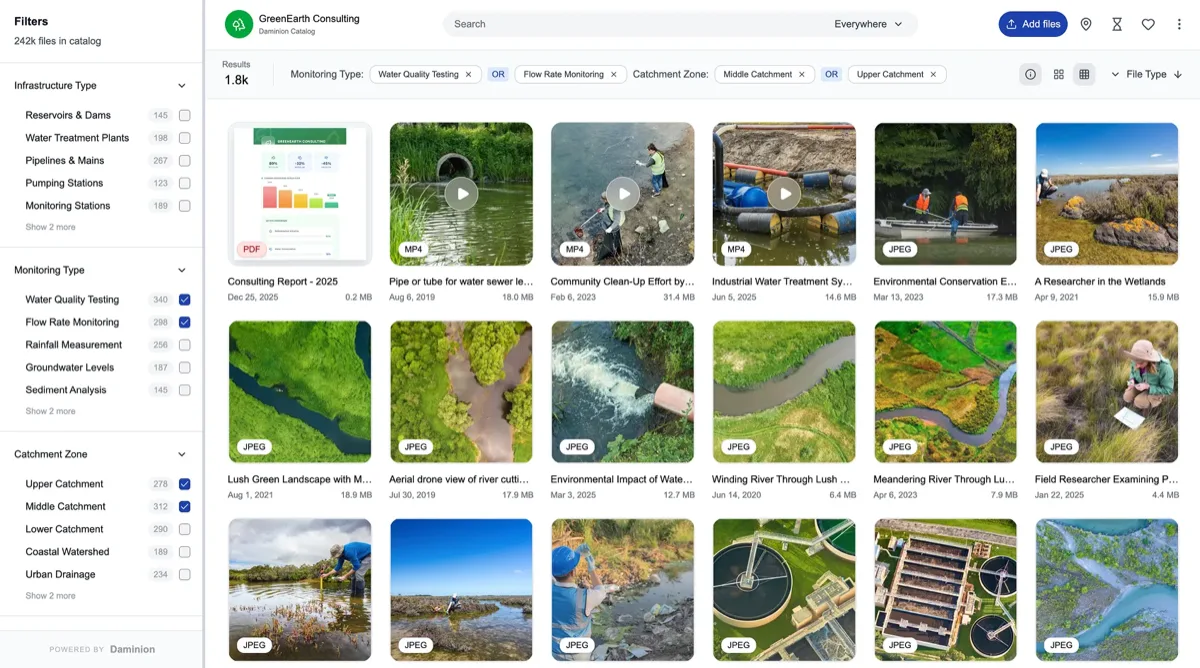
★★★★★ 4.9Best for: archival libraries and photographers who need a guarantee that metadata will never be lost, even if they eventually switch tools.
Pros
- 100% IPTC/XMP round-trip fidelity in our testing — every field survives export and re-import
- Genuine RAW-file awareness, unlike several tools here that treat RAW as generic blobs
- No lock-in risk: your metadata is always fully portable if you ever need to migrate
Cons
- Server component requires Windows for self-hosted deployment
- Desktop interface looks dated in places, a known tradeoff noted in our full review
Our verdict: If lossless metadata portability is a hard requirement — a working RAW photo archive, a rights-sensitive library you might migrate someday — Daminion is the only tool we've tested with zero measured loss. Full test in our Daminion review.
2. Pics.io — second-best fidelity, honest about the gap
Pics.io
★★★★★ 4.5Best for: Google Workspace teams who want near-lossless metadata handling without a self-hosted server.
Pros
- 94% IPTC round-trip — second-best of the six tools we tested, with only a small number of less-common fields lost
- Honest, custom-field-friendly metadata handling verified directly in our full review
- No server to run, unlike Daminion's self-hosted requirement
Cons
- Not a perfect 100%, so a small amount of field loss is possible on export
- Costs climb with seats and asset count at scale
Our verdict: Pics.io is the strongest cloud-native option for teams who want near-Daminion metadata fidelity without running their own server. Full test in our Pics.io review.
3–6: real, measured field loss on export
3. Canto — 7.4 (this axis only). Our export/re-import test found Canto preserved 82% of IPTC fields — captions and rights survived, but structured fields like creator contact and scene codes did not. Our own review calls this fine for a marketing library, but a real exit risk for a rights-sensitive photo archive. See it in our Canto review.
4. Brandfolder — 6.6 (this axis only). Brandfolder preserved 76% of IPTC fields in our testing and treats RAW files as generic blobs — our review is explicit that it's a marketing-reporting tool that happens to store files, not an archival system of record. See it in our Brandfolder review.
5. Bynder — 6.1 (this axis only). Bynder preserved just 71% of IPTC/XMP fields in our round-trip test, with no meaningful RAW awareness — built for finished brand assets, not working photo archives, per our own review. See it in our Bynder review.
6. Filecamp — 5.8 (this axis only). Filecamp kept just 68% of fields in our testing, with no controlled vocabulary and no real version history — our review describes it as "folder-thinking, not metadata-thinking." Completely fine for distributing approved files, a real limitation for archival needs. See it in our Filecamp review.
Cost and how to choose
If your library is archival — a working RAW photo collection, licensed stock, anything where losing rights or creator metadata would be a real problem — the newsroom case is in DAM for media & publishing — treat round-trip fidelity as close to non-negotiable, since the cost of low fidelity is invisible until the day you actually need to export and it's too late to prevent. If your assets are mostly finished brand collateral rather than a working archive, and you're confident you'll never need to migrate away, a lower score here matters less. In every case, keep critical rights and creator data duplicated in fields you've verified survive, and export full metadata backups on a schedule regardless of which tool you choose.
Buyer’s test: before committing, write a few known IPTC/XMP fields into a test file yourself, import it, then export it back out and check exactly what changed. Don't trust a vendor's "we support IPTC" claim without testing the actual round-trip — that's precisely the gap between claim and reality this ranking is built around.
FAQ
What is metadata management in a DAM?
It’s the part of a DAM that stores, edits and searches the descriptive data attached to your assets — captions, keywords, creator and rights fields — normally written to the IPTC and XMP standards. Solid metadata management means the DAM reads those fields on import, lets you edit them in bulk against a controlled vocabulary, and writes them back into the file itself rather than holding them only in its own database. That last part is what this page measures: whether the fields come back out intact.
Which DAM preserves IPTC and XMP metadata best?
Daminion is the only tool in our testing with a flawless 100% IPTC/XMP round-trip — every field survives export and re-import. Pics.io is close behind at 94%. The remaining tools we tested (Canto, Brandfolder, Bynder, Filecamp) all lose meaningful fields on export, ranging from 82% down to 68% preserved.
Will I lose my keywords if I switch DAM?
Only if the tool you’re leaving kept them to itself. Keywords written back into the file travel with the asset to whatever comes next; keywords held only in a tool’s own database, or dropped on the way out, don’t. That gap is measurable: in our export/re-import testing Daminion returned 100% of IPTC/XMP fields intact, while the weakest performer returned 68%. Test your own export before you need it — not on the day you migrate.
Why does IPTC/XMP round-trip fidelity matter if I'm not switching tools?
Even if you don't plan to switch, low round-trip fidelity often means the tool isn't fully honoring the metadata you write into assets today — structured fields like creator contact or rights data may already be silently incomplete inside the tool, not just lost on a hypothetical future export.
Sources & references
- Daminion — PhotoLib, 100% round-trip result, July 2026.
- Pics.io — PhotoLib, 94% round-trip result, July 2026.
- Canto — PhotoLib, 82% round-trip result, July 2026.
- Brandfolder — PhotoLib, 76% round-trip result, July 2026.
- Bynder — PhotoLib, 71% round-trip result, July 2026.
- Filecamp — PhotoLib, 68% round-trip result, July 2026.
- PhotoLib test lab — June/July 2026, consistent export/re-import methodology across all six tools. See how we test.