Our verdict in 30 seconds: for a real tagging workflow — hierarchical keywords, a controlled vocabulary, bulk apply, and tags written back into the file — Daminion is our pick, the only tool we’ve tested that does all four well. Pics.io is the strongest cloud option. Canto and Bynder lean on AI auto-tagging; Brandfolder is marketing-first; Filecamp is folder-thinking, not tagging. If AI auto-tagging is the headline feature you want, see our Best AI DAM software ranking instead — this page ranks the whole keywording workflow, manual and AI-assisted.
What makes tagging software good — beyond “it has tags”
Almost every tool lets you slap a label on an image. That’s not what separates them. A tagging workflow that actually scales rests on four things, and most tools are strong on one or two and weak on the rest. Hierarchical keywords let “Vehicles > Car > Convertible” behave as one structure, so tagging a convertible also makes it findable under “vehicles.” A controlled vocabulary stops “car,” “cars” and “automobile” fragmenting your library. Bulk apply is what makes tagging a 2,000-image shoot survivable. And writing tags back into the file as IPTC/XMP is what keeps them yours — portable to whatever tool comes next — rather than trapped in one vendor’s database. Tagging is only half the job, though; the cataloguing half is ranked separately in our photo library management comparison.
AI auto-tagging is genuinely useful, and every good tool here has some form of it — but it’s an accelerator, not the workflow. It gets you a fast first pass of generic subjects (“beach,” “person,” “sunset”) that a human then corrects and augments with the terms that actually matter to your business. A tool that’s only AI tags, with no controlled vocabulary to reconcile them against and no way to write them into the file, gives you a library that’s easy to tag and hard to trust. We rank the workflow, and treat AI as a plus on top of it.
Quick comparison
| Tool | Tag-workflow strength | What stands out | Tier | Score |
|---|---|---|---|---|
| 1. Daminion | Complete | Hierarchical keywords + controlled vocabulary, bulk apply, writes IPTC/XMP back to the file | $ | 9.6 |
| 2. Pics.io | Strong (cloud) | Custom fields, AI tagging, writes keywords back into your Google Drive/S3 files | $$ | 8.9 |
| 3. Canto | AI-led | Strong AI auto-tagging and natural-language search; lighter on manual vocabulary control | $$ | 8.0 |
| 4. Bynder | Governed, enterprise | AI tagging plus taxonomy governance at scale; built for finished brand assets | $$$ | 7.7 |
| 5. Brandfolder | AI-first, shallow files | Auto-tagging and usage analytics, but treats RAW as generic blobs | $$$ | 7.1 |
| 6. Filecamp | Basic labels | No controlled vocabulary; folder-thinking, not metadata-thinking | $ | 5.9 |
Price tiers: $ budget · $$ mid-range · $$$ enterprise, quote-based. Scores reflect tag-workflow quality specifically for this ranking, not each tool’s overall PhotoLib score — several score higher on other axes. Capability facts are drawn from our own hands-on reviews and metadata testing. Checked July 2026.
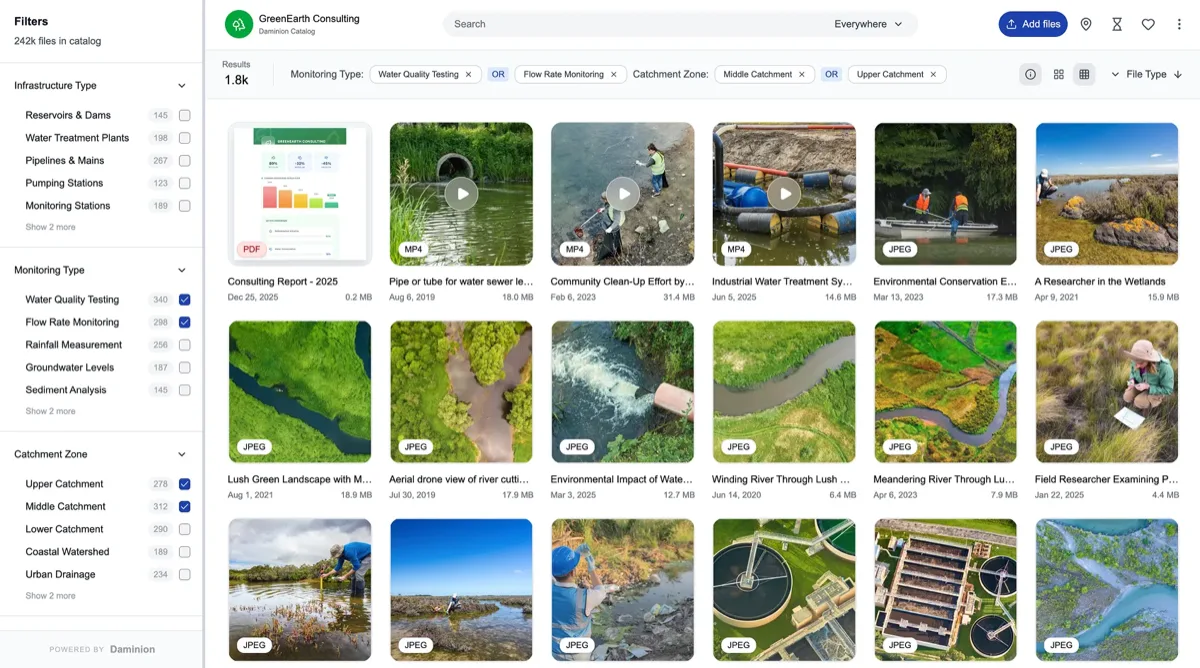
1. Daminion — the complete tagging workflow
Daminion
★★★★★ 4.8Best for: teams and photographers who tag seriously — a large library that has to stay findable and portable for years.
Pros
- Hierarchical keywords and a controlled vocabulary — the two features most tools force you to choose between
- Fast bulk tagging across a whole shoot, then per-image refinement
- Writes tags back into the file as IPTC/XMP — 100% round-trip in our metadata fidelity testing, so your keywords stay portable
- Genuine RAW awareness and an optional AI keywording add-on for a fast first pass
Cons
- Self-hosted server component requires Windows
- Desktop interface looks dated next to the cloud tools
Our verdict: If tagging is a core job rather than an afterthought — a working archive that must stay searchable and portable — Daminion is the most complete workflow we’ve tested, and the only one strong on all four axes at once. Full test in our Daminion review.
2. Pics.io — the strongest cloud tagging workflow
Pics.io
★★★★★ 4.4Best for: Google Workspace teams that want serious tagging without running a server.
Pros
- Flexible custom fields and keywords, with AI tagging for a fast first pass
- Writes keywords back into the actual files in your own Google Drive or S3 — 94% round-trip in our metadata testing
- No server to run, unlike Daminion’s self-hosted requirement
Cons
- Tied to Google Drive/S3, with no on-premise option
- Controlled-vocabulary governance is lighter than Daminion’s
Our verdict: The best cloud-native pick for teams who tag in earnest but don’t want infrastructure — near-Daminion portability because it writes tags into the files you already own. Full test in our Pics.io review.
3–6: the rest of the field
3. Canto — 8.0 (this axis only). Canto’s tagging is AI-led and it’s good at it — strong auto-tagging and the best natural-language search of the cloud tools we’ve tested, so “find the red dress on the beach” tends to work. The trade is manual control: it leans on AI subjects more than on a tightly governed controlled vocabulary, and in our metadata testing it returned 82% of IPTC fields on export, losing some structured fields. A fine tagging tool for a marketing library; less so for an archive you need to keep portable. See our Canto review.
4. Bynder — 7.7 (this axis only). Bynder brings AI tagging together with real taxonomy governance — the ability to enforce one vocabulary across hundreds of users, which is exactly what a large brand needs. It’s built for finished brand assets rather than working photo archives, has no meaningful RAW awareness, and arrives at enterprise price and rollout. If the tagging problem you’re solving is consistency across a big organisation, it’s a serious option; for a photographer’s library it’s overkill. See our Bynder review.
5. Brandfolder — 7.1 (this axis only). Brandfolder’s auto-tagging is capable and its usage analytics are a genuine draw, but its model is marketing-reporting first: it treats RAW files as generic blobs and kept 76% of IPTC fields in our testing. Tagging is AI-assisted rather than a deep manual keywording workflow, which suits a brand-asset library more than a photo catalogue. See our Brandfolder review.
6. Filecamp — 5.9 (this axis only). Filecamp is honest about what it is: a cheap, unlimited-user way to share approved files, organised around folders and simple labels. There’s no controlled vocabulary and, as our review puts it, it’s “folder-thinking, not metadata-thinking.” Perfect for distribution; not a tagging tool once your library outgrows folders. See our Filecamp review.
The thing that makes tagging survivable at volume is doing it in the right order: bulk first, detail second. Select the whole shoot and apply everything it shares in one pass — shoot name, date, location, rights, the broad keywords — then go back for the per-image specifics. Teams that tag image-by-image from scratch burn a day on a shoot and quietly give up; teams that bulk-apply the shared eighty percent first are done in twenty minutes and actually keep the habit. When you trial a tool, tag a batch, not a single file — that’s the test of whether its tagging scales.
Cost and how to choose
Match the tool to how much tagging actually matters to you. If your library is a working archive that must stay findable and portable — photography, licensed stock, anything you might migrate someday — prioritise the two features most tools skimp on: a controlled vocabulary and writing tags back into the file. That points to Daminion (budget-tier licence, self-hosted or its own cloud) or Pics.io (from around $100/month on your own storage). If your assets are finished brand collateral and the real problem is consistency across a big team, Bynder’s governance earns its enterprise price. And if you mostly need to hand approved files out, Filecamp’s flat price is fine — just don’t expect it to be a tagging system.
Buyer’s test: tag a handful of images in the trial, then export them and open the files somewhere else. If your keywords are still in the file, the tool writes IPTC/XMP and your tagging work is portable. If they vanished, the tags lived only in the vendor’s database — and you’ll lose them the day you leave. That single test separates a tagging tool from a labelling toy.
Sources & references
- PhotoLib metadata fidelity testing — our own IPTC/XMP round-trip results, the source of the portability figures cited here.
- IPTC Photo Metadata Standard — the keyword and rights fields tags are written into, accessed July 2026.
- Daminion — Editor’s Choice; hierarchical keywords and controlled vocabulary referenced here, vendor site, accessed July 2026.
- PhotoLib methodology — how we test and score DAM tools. See our methodology.
Keep reading
FAQ
What is the best image tagging software in 2026?
For a complete tagging workflow - hierarchical keywords, a controlled vocabulary, bulk apply, and tags written back into the file as IPTC/XMP - Daminion is our pick, and the only tool we've tested that is strong on all four. Pics.io is the best cloud option because it writes keywords into the files in your own Google Drive or S3. Canto and Bynder are strong on AI auto-tagging; Filecamp is folder-based labelling rather than real tagging.
What is the difference between image tagging software and an AI DAM?
They overlap but emphasise different things. AI DAM software leads with automatic tagging and visual or natural-language search as the headline feature - see our Best AI DAM software ranking. Image tagging software is judged on the whole keywording workflow: how well you can apply hierarchical keywords in bulk, keep a controlled vocabulary consistent, and write those tags back into the files. AI auto-tagging is a useful accelerator within that workflow, not a replacement for it.
Can I bulk tag thousands of photos at once?
Yes, in a proper tagging tool. Bulk apply is what makes tagging a large shoot survivable: you select a whole batch and apply the shared keywords, shoot name, date, location and rights in one pass, then refine the per-image details individually. Tools like Daminion and Pics.io are built for this; a folder-based sharing tool like Filecamp is not, which is why it sits at the bottom of this ranking.
Does image tagging software write keywords into the file?
The good ones do, and it matters more than any other single feature. Keywords written into the file as IPTC or XMP travel with the asset to whatever tool comes next; keywords held only in a vendor's database are lost the day you migrate. In our metadata round-trip testing Daminion returned 100% of fields and Pics.io 94%, while the weakest tool returned 68%. Test your own export during the trial before you commit.
Is AI auto-tagging good enough on its own?
As a first pass, yes; as the whole workflow, no. AI reliably tags generic subjects - beach, person, sunset - which saves real time, but it doesn't know the terms specific to your business, and without a controlled vocabulary to reconcile against, its output drifts. The strongest setup is AI for the fast first pass, then a human confirming and adding the terms that matter, against a controlled vocabulary, written back into the file.