Our verdict in 30 seconds: Filecamp (8.8) is built specifically around per-client folder structures at a price that works even for a small agency with many small accounts. Canto (9.0) is the pick once an agency's library gets large enough that natural-language search beats browsing client folders manually. Daminion fits an agency doing its own heavy photo/video production in-house. Pics.io is the natural choice if the agency already lives inside Google Workspace with clients.
What's actually different about an agency's DAM problem
A single in-house marketing team organizes assets by campaign. An agency organizes by client — and needs each client's folder walled off from every other client's, needs to hand a freelancer temporary access to exactly one project without exposing the rest of the account roster, and needs a fast way for a client to review and approve a batch of creative without an email thread of attachments. Those three needs — client isolation, freelancer access control, and fast external review — are what we tested for here, not general enterprise features. A fourth, for agencies that resell access, is white-labeling: presenting the platform under your own brand rather than the vendor’s.
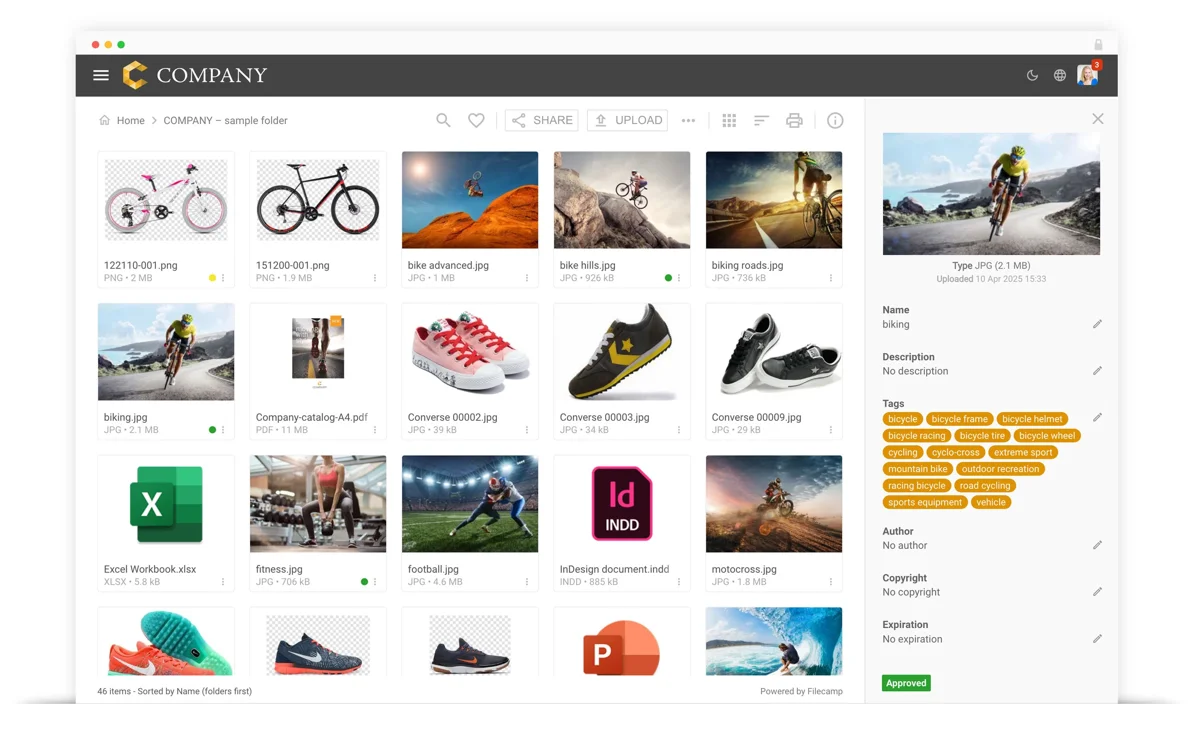
My test: set up two client folders, invite a test "freelancer" account to only one of them, and check from that account's own view whether the other client's folder is visible anywhere — in navigation, search results, or a URL a curious person could just edit. Filecamp's per-client folder permissions passed this cleanly out of the box; it's the detail that matters most for an agency handling competing brands, where one client glimpsing another's unreleased creative isn't just embarrassing, it can be a contract-ending mistake.
Quick comparison
| Tool | Agency strength | Best for | Tier | Score |
|---|---|---|---|---|
| 1. Filecamp | Per-client folder isolation, budget-friendly at scale | Many small-to-mid client accounts | $ | 8.8 |
| 2. Canto | Natural-language search across a large multi-client library | Large agencies with many active clients | $$ | 9.0 |
| 3. Daminion | Deep in-house photo/video production catalog | Agencies producing their own heavy creative in-house | $ | 8.6 |
| 4. Pics.io | Built on Google Drive, zero new tool to learn for clients | Agencies already living in Google Workspace | $$ | 8.1 |
Price tiers: $ budget · $$ mid-range, quote-based at higher tiers. Scores reflect fit for agency-specific workflows in this ranking, not each tool's overall PhotoLib score. Checked July 2026.
1. Filecamp — built for many-client folder isolation
Filecamp
★★★★★ 4.4Best for: agencies juggling many client accounts who need clean folder isolation without enterprise pricing.
Pros
- Per-client, per-folder permissions passed our isolation test cleanly out of the box
- Unlimited users on most plans, useful for agencies constantly rotating freelancers in and out
- Branded external review links make client approval fast without an email attachment thread
Cons
- Search is more folder-driven than Canto's natural-language search — better suited to smaller per-client libraries than one huge combined one
- Fewer AI-powered features than Canto or Daminion's AI add-on
Our verdict: If the core job is "keep a dozen client accounts cleanly separated and let clients approve creative fast," Filecamp does that directly, at a price that doesn't punish an agency for having many smaller accounts rather than one huge one.
2. Canto — best search once the library gets large
Canto
★★★★★ 4.6Best for: larger agencies where the combined multi-client library has grown too big to browse by folder alone.
Pros
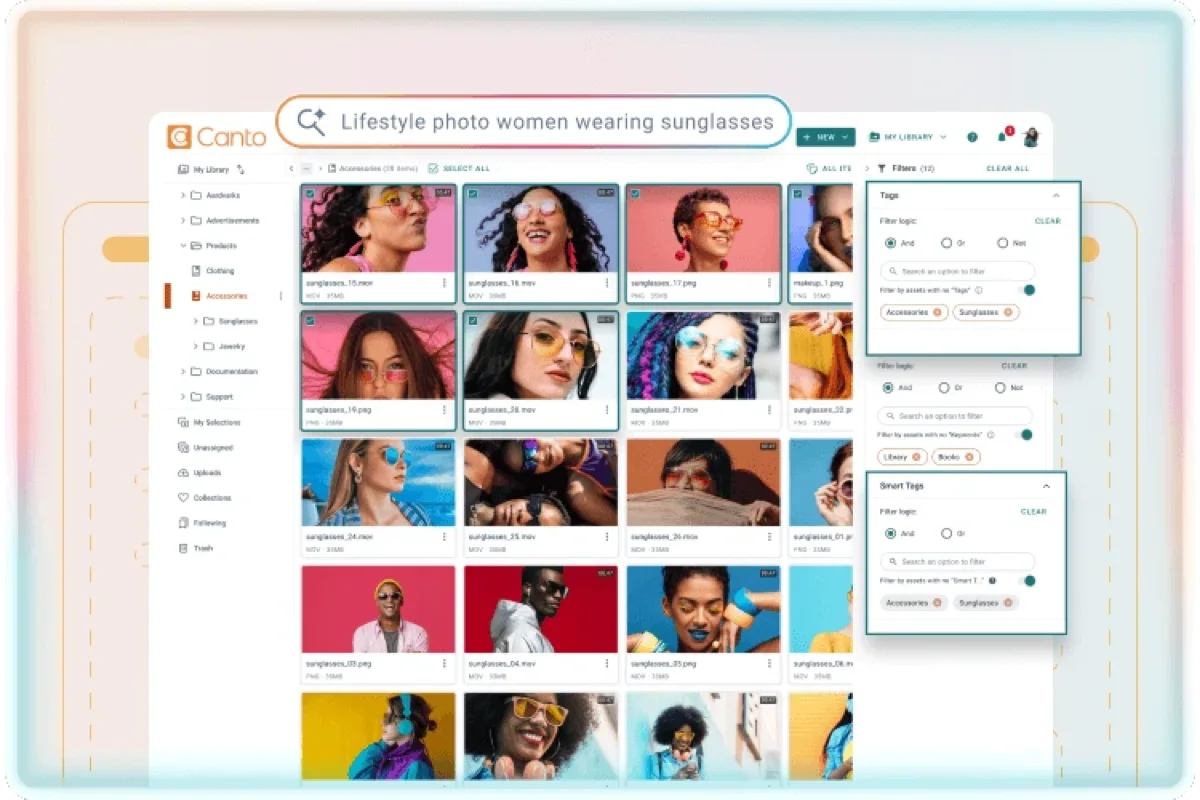
- Natural-language search scales well past the point where folder browsing gets slow
- Shareable collections work well for client-facing review links
- Fast onboarding for account managers who aren't technical
Cons
- Client-isolation permissions are less granular by default than Filecamp's per-client folder model
- Mid-range pricing climbs faster than Filecamp's as the agency adds client accounts
Our verdict: Once an agency's combined library is large enough that "which client folder was that in again" becomes a real time cost, Canto's search is worth the higher price over Filecamp's folder-first model. Full test in our Canto review.
In-house production and the Google-native option
Two more picks, for agencies whose constraint is not client isolation: one that also produces heavy work in-house, one whose clients refuse to learn another tool.
3. Daminion — 8.6: when the agency also produces the work
The right pick for an agency that isn't just organizing client-supplied assets but producing its own heavy photo and video work in-house — product shoots, video edits, a growing internal creative archive alongside client folders. Its AI tagging add-on and per-image pricing suit that production-heavy workload well, though its client-folder isolation isn't quite as purpose-built as Filecamp's. See it in our Daminion review.
4. Pics.io — 8.1: no new login for the client
Built directly on Google Drive, which means zero new login or interface for any client who already uses Google Workspace — a real advantage when onboarding a client who doesn't want to learn another tool just to review creative. The trade-off is that isolation and permissions are really Google Drive's own sharing model, not a DAM-specific client-separation feature, so a careless folder-sharing mistake carries the same risk it would in plain Drive. Best for: Workspace-native agencies whose clients will not onboard. See it in our Pics.io review.
Multi-client agencies: isolation, collection and delivery
The workflow a generic DAM ranking skips is the one every multi-client shop lives in daily, and it splits into three jobs that pull in different directions. Advertising and marketing agencies rarely fail on raw storage — they fail on keeping these three straight across a dozen accounts at once.
Isolation. Each client’s assets belong in their own permissioned workspace, invisible to every other client and to any freelancer who isn’t on that account. This is where Filecamp’s per-client folder permissions earned the top spot — they passed our guest-account isolation test out of the box. Whatever you shortlist, confirm client isolation from a test guest’s own point of view, and see our DAM with granular permissions ranking for tools built around exactly this.
Collection. Getting raw assets from a client is the step agencies most often improvise with shared drives and email attachments. Look for a client-facing upload portal or request link that drops files straight into the correct client folder without the client needing an account — check any shortlisted tool for this specifically, because it varies far more than vendors let on, and confirm incoming files land inside that client’s isolated workspace rather than a shared inbox.
Delivery. Sending finished creative back should be a branded share link with review and approval built in, not another attachment thread. Filecamp’s branded external review links and Canto’s shareable collections both cover this on the tools above; if you resell access under your own name, weigh a dedicated brand portal as well. Keep every delivery link scoped to the one client, so an approval round never exposes another account’s work.
Cost and how to choose
Start with how many clients you're actually juggling and how big each account's library gets. A handful of small-to-mid accounts with straightforward folder needs — Filecamp fits directly and won't punish you for having many smaller accounts instead of one big one. A large combined library where staff waste real time hunting through folders — Canto's search earns its higher price. Heavy in-house production alongside client work — Daminion's per-image pricing and AI tagging suit that better than either. Already living in Google Workspace with your clients — Pics.io removes onboarding friction entirely, at the cost of DAM-specific permission granularity. Whichever you pick, don't skip testing actual client isolation before signing — ask to see it from a test guest account's own point of view, not just the admin dashboard.
Buyer’s test: before buying, set up two test client folders yourself and invite a freelancer-level guest account to only one of them. Check from that guest account whether the other client's folder appears anywhere — in navigation, in search results, or reachable by editing a URL. This is the single test that would have caught most agency data-leak incidents we've heard about.
FAQ
What's the best DAM software for a creative agency?
Filecamp is the best fit for most agencies because its per-client folder permissions cleanly isolate each account, at a price that scales with many smaller clients rather than punishing you for not having one giant account. Canto is worth the higher price once your combined multi-client library gets too large to browse by folder, since its natural-language search handles scale better.
How do agencies keep different clients' assets separate in a DAM?
Through per-client folder or workspace permissions that prevent one client's guest account from seeing another client's content in navigation, search, or via a guessable URL. This should be tested directly from a test guest account's own point of view before buying, not assumed from the admin dashboard's permission settings alone.
What's the best DAM software for an advertising or marketing agency?
The same picks lead for advertising and marketing agencies as for any multi-client shop: Filecamp for clean per-client folder isolation at a price that scales with many smaller accounts, and Canto once the combined library grows too large to browse folder by folder. Both wall each client's work off from the others and give account managers fast branded review links to send creative for sign-off.
How can an agency collect assets from clients easily?
The easiest pattern is a client-facing upload portal or request link that lets a client drop raw files straight into the right folder without creating an account. Not every DAM includes one, so check any shortlisted tool for a request or upload feature specifically rather than assuming it — and confirm the incoming files land inside that client's isolated workspace, not a shared inbox everyone can see.
How do agencies deliver finished creative to clients for approval?
Through a branded share link with review and approval built in, rather than emailing attachments back and forth. On this page, Filecamp's branded external review links and Canto's shareable collections both do this; agencies that resell under their own brand should also look at a dedicated brand portal. Keep each delivery link scoped to the one client so an approval round never exposes another account's work.
Sources & references
- Filecamp — vendor site, accessed July 2026.
- Canto — vendor site, accessed July 2026.
- Daminion — vendor site, accessed July 2026.
- Pics.io — vendor site, accessed July 2026.
- PhotoLib test lab — June/July 2026, client-isolation guest-account tests across four tools. See how we test.